Master’s research · Sungkyunkwan University

Seungho Jung

Medical AI Researcher

MS ECE · SKKU

Researcher focusing in domain-specific tasks, mainly in Medical AI, for more studies that have real-world applicability without increasing hardware requirement costs.
Seungho Jung
Seungho JungGenerative models · Computer vision

Research interests

Generative models

Diffusion models and learned visual representations.

Computer vision

Model adaptation, segmentation, and contrastive learning.

Medical image analysis

Forecasting and image analysis for aiding radiologists.

Scroll to explore

Academic background

I'm Seungho Jung. My master's research at Sungkyunkwan University's ECE department and Media System Laboratory (MSL) focuses on generative models, computer vision, and medical image analysis.

With 3 published papers, 2 accepted papers and 1 paper in progress, my work spans from medical vision models and representation learning to industrial applications. My background in software development supports the implementation of research ideas.

3Publications
4.42GPA / 4.5
4+Years Dev

Education

MS ECESKKU · 2025–Present · GPA 4.42/4.5
BS EESKKU · 2019–2025 · GPA 3.46/4.5

Languages

English Native Korean Native Mandarin Conversational Tagalog Conversational
TOEIC990/990
OPIcAL

Research experience & practice

Graduate Researcher

Current
Media System Laboratory (MSL)2025 – present

Research on Generative Models and Computer Vision at Sungkyunkwan University. Part of this work is conducted as an outsourced researcher for Crescom, focusing on practical applications of diffusion models and image analysis.

Freelance Developer

WaterbeFreelance

Frontend and backend web development. Contributed across the full stack.

Undergraduate Researcher

SKKU Media System Laboratory2024.02 – 2025.02

12 months of research experience within the university lab.

Developer

NNS Company2021 – 2024

Multiple development projects: NLP natural language classifier (2021), Arduino-based water control system (2023), KNN pest & disease classifier (2023), Node.js/Express website (2023–2024).

Programming Tutor

평정 학원2022.12 – 2023.02

Taught C++, Java, and Python fundamentals to students.

Research & publications

3 published · 2 accepted · 1 in progress

First-author papers

4 papers
ICISPC 2026July 12, 2026

Efficient Autoencoding with Quadtree-based Visual Transformer Encoder

Seung Ho Jung, Kyu Hoon Moon, Geonhyeok Lee, Jitae Shin

Accepted
At a glance & figure

Spend fewer image tokens on simple backgrounds, then restore a dense grid for reconstruction.

  1. 01Entropy-based quadtree patches
  2. 02Compact ViT encoding
  3. 03Mask-token grid restoration
Compute vs. dense ViT-B
17.5% less
Reconstruction PSNR
29.60 dB

STL-10 benchmark: 36.21 vs. 43.88 GFLOPS; PSNR 29.60 vs. 34.03 dB for dense ViT-B (Table 1, p. 8).

Trade-off: less computation, but lower reconstruction quality than the dense baseline and visible artifacts in some skipped regions.
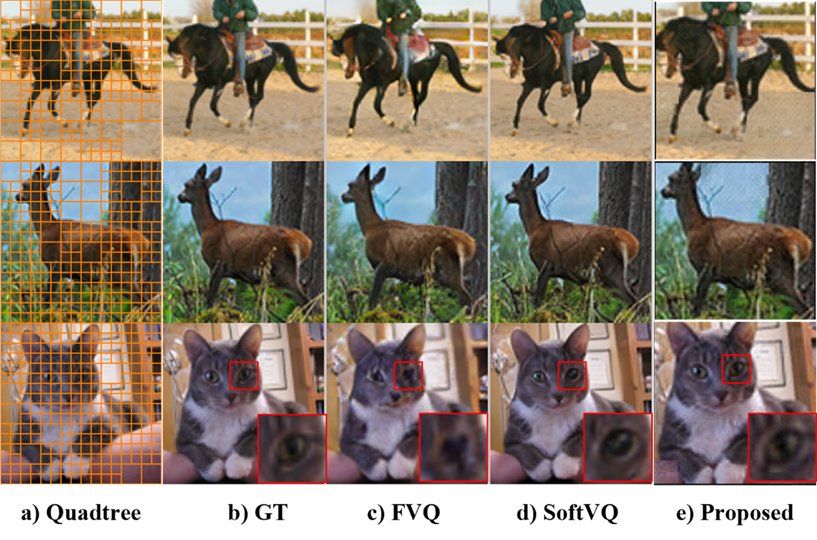
Five-column reconstruction comparison with quadtree patches, ground truth, FVQ, SoftVQ and the proposed method; red boxes and enlarged insets compare details around the cat eye.
Author-supplied qualitative comparison: quadtree allocation, ground truth, FVQ, SoftVQ and the proposed method. Red insets show magnified reconstruction detail. Enlarge figure
ICCRD 2026May 12, 2026

Dual-Manifold Alignment Contrastive Learning for Knee Osteoarthritis Prediction

Seung Ho Jung, Jae Joon Lee, Jitae Shin

Published
At a glance & figure

Predict four-year knee osteoarthritis progression without assuming every patient follows the same path.

  1. 01One baseline knee X-ray
  2. 02Present and future latent spaces
  3. 03Align stability; separate progression
Progression-risk AUC
0.7638
Prediction horizon
48 months

OAI cohort of 4,796 image pairs with Site D held out for validation/test. Compared baseline AUC: 0.7289 (Table I, p. 4).

The input is a baseline radiograph; future grades provide training supervision. Results describe the reported OAI evaluation.
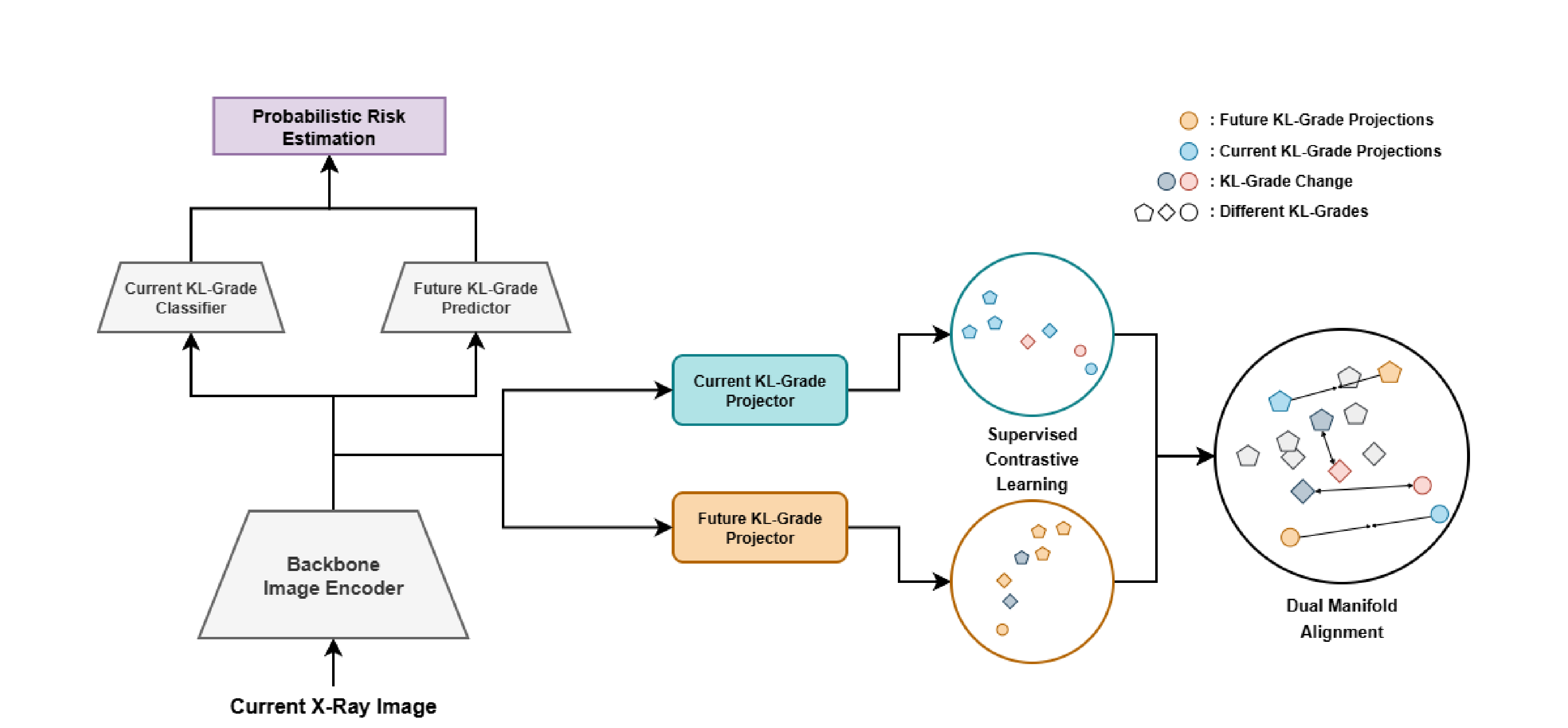
A baseline X-ray passes through a shared encoder to current and future grade heads and separate latent projections, followed by dual-manifold alignment.
Figure 2, p. 3. DuMA-CLR architecture from the ICCRD manuscript. Enlarge figure
ITC-CSCC 2025July 7, 2025

Medical SAM Adapter++: Adaptive Normalization with Domain Interpretation for Better Adaptation

Seung Ho Jung, Jae Joon Lee, Jitae Shin

Published
At a glance & figure

Use image-level domain context to adapt SAM normalization for medical segmentation.

  1. 01Extract image statistics
  2. 02Interpret domain context
  3. 03Condition adaptive normalization
OAI Dice, full model
66.33%
Gain over Med-SA
+3.79 pp

Noisy OAI ablation: Dice rises from 62.54% to 66.33%; IoU from 51.04% to 53.61% (Table II, p. 5).

This comparison isolates AdaLN and the domain interpreter. The separate denoised experiment reports different scores.
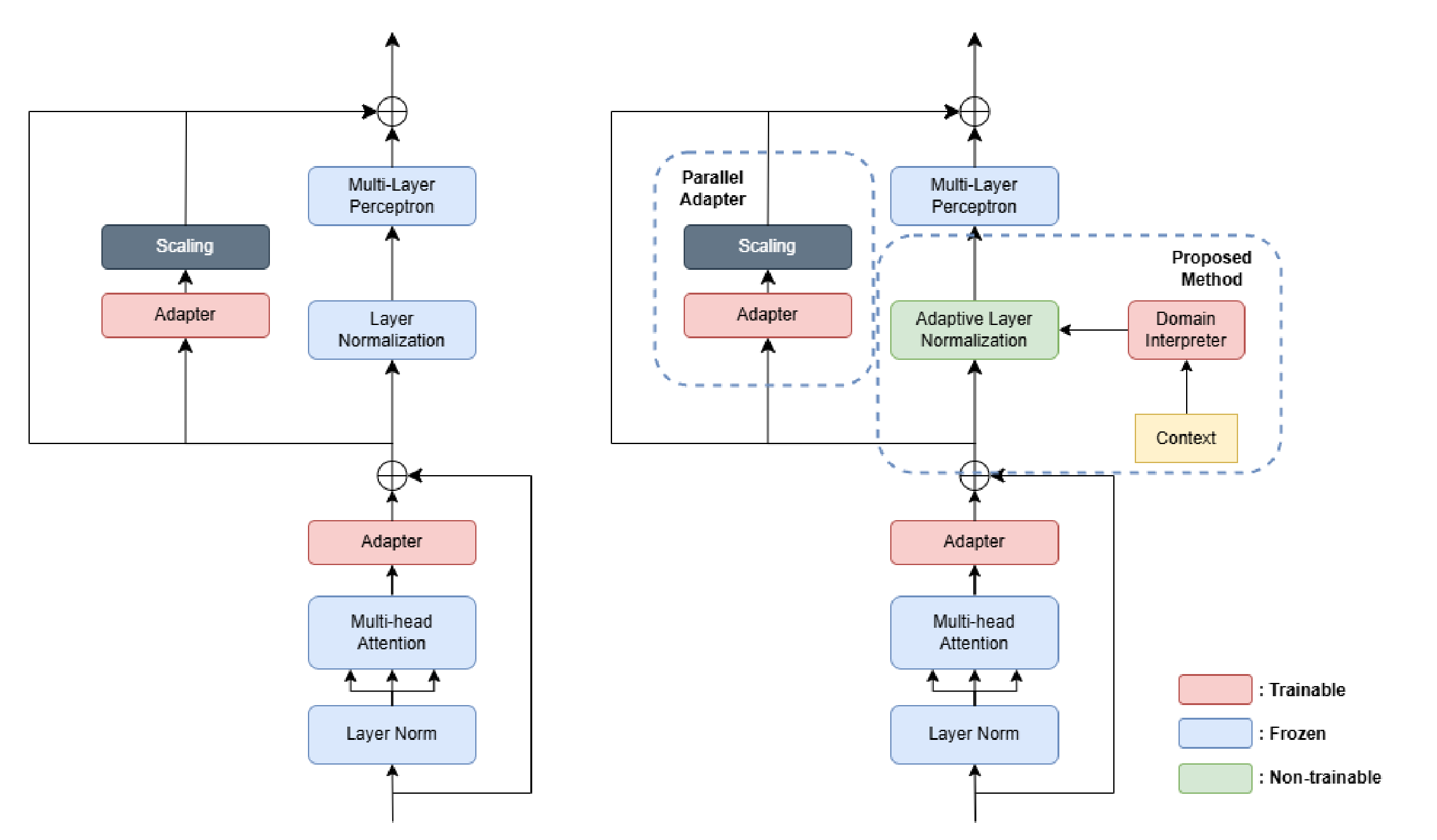
Med-SA encoder alongside Med-SA++, which adds a domain interpreter that conditions adaptive layer normalization.
Figure 2, p. 3. Baseline and proposed encoder from the ITC-CSCC manuscript. Enlarge figure
Upcoming

Upcoming Publication

Seung Ho Jung

In Progress

Second-author papers

2 papers
ECML PKDD 20262026

Probabilistic Dynamic Causal Graphs for Root Cause Analysis with Distributional Forecasting

Hyunmin Kong, Chunsoo Ahn, Seung Ho Jung, Seung Yeol Yoo, Donghwi Shin, Jitae Shin

Accepted
At a glance & figure

Trace anomalous sensor readings back to likely causes while accounting for changing, uncertain relationships.

  1. 01Learn dynamic causal graphs
  2. 02Calibrate forecast uncertainty
  3. 03Rank residual and structural deviations
MSDS root-cause AC@1
0.827
SWaT root-cause AC@3
0.517

Mean AC@K on industrial benchmarks: MSDS AC@1 = 0.827 +/- 0.102; SWaT AC@3 = 0.517 +/- 0.037 (Table 3, p. 12).

AC@K measures recovery of root-cause variables among the top K candidates. The model does not lead every metric; RCG has higher SWaT AC@1.
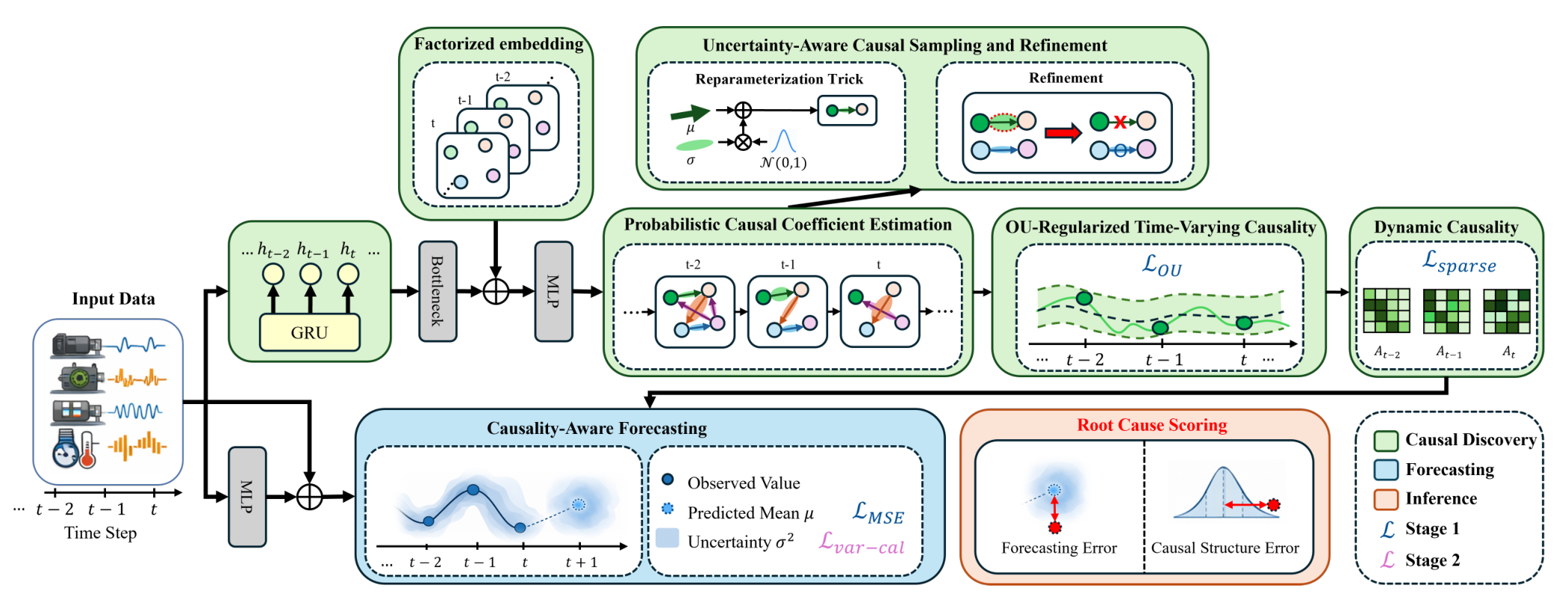
Sensor time series feed dynamic causal graph estimation and distributional forecasting; forecast errors and causal structure errors combine to rank root causes.
Figure 1, p. 4. Probabilistic causal discovery and root-cause scoring from the ECML PKDD manuscript. Enlarge figure
Sensors 2024October 27, 2024

Breast Lesion Detection for Ultrasound Images Using MaskFormer

Aashna Anand, Seung Ho Jung, Sukhan Lee

Published
At a glance & figure

Locate breast lesions and assign their class within one ultrasound-image model.

  1. 01Ultrasound image features
  2. 02MaskFormer mask classification
  3. 03Lesion masks and class labels
Mean average precision
0.943
Malignant-lesion recall
0.900

Breast Ultrasound Image Dataset; reported 80/10/10 train/test/validation split. Results from Tables 4 and 5, pp. 12 and 14.

Illustrated cases include small, multiple and low-contrast lesions. The model predicts masks and normal, benign or malignant labels in a single framework.
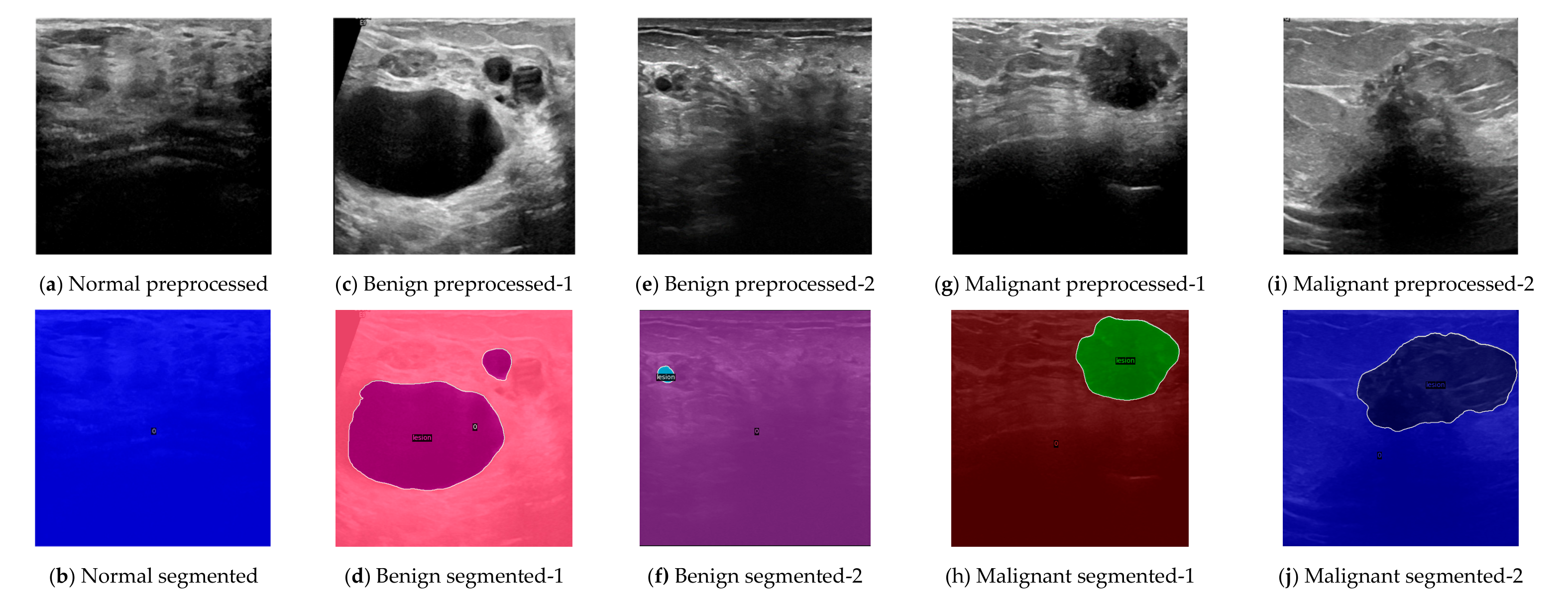
Five ultrasound examples above their predicted segmentation masks: normal tissue, two benign cases and two malignant cases.
Anand, Jung and Lee, Sensors 2024, Figure 3, p. 11 (CC BY 4.0). Figure area extracted; panel labels retained. Enlarge figure

Supporting engineering work

2024

Next-Generation Functional Desk

A desk integrating wireless power transmission and handwritten text recognition.

Application
Wireless power transmission and reception integrated into a functional desk.
Implementation
A CNN-based OCR model converts handwritten letters to machine text.
ArduinoCNNOCRPythonWireless Charging
2023

KNN Pest Disease Classifier

Image classification for agricultural pests and plant diseases, developed for NNS.

Application
Identify plant diseases from images.
Implementation
K-Nearest Neighbors classification using Python and OpenCV.
PythonKNNOpenCV
2021

NLP Natural Language Classifier

A natural language classification system developed for NNS Company.

Application
Categorize text input.
Implementation
Natural language processing techniques implemented in Python.
PythonNLP
2023

Arduino Water Control System

An automated water control system developed for NNS Company.

Application
Automate water control.
Implementation
Arduino sensors and actuators, programmed in C++.
ArduinoC++

Methods & tools

Languages

PythonC++JavaJavaScript

ML / AI

PyTorchOpenCVDiffusion ModelsSAM

Web

Node.jsExpressReact

Tools

GitLinuxArduino

Contact me.

Interested in discussing research, collaboration, or opportunities in machine learning and medical image analysis.